Investigative Analysis · Procedural Examination
The First Police Move: The Cellphone Seizure
An examination of how early actions — and the records that describe them — may diverge when placed side by side.
Why early moments matter.
In investigative analysis, the earliest moments often carry the greatest weight.
Initial actions can shape not only what follows, but how a case is later understood — particularly when they involve the handling of personal property.
This page presents a structured breakdown of one such moment, drawing from narrative descriptions, administrative records, and supporting documentation.
May 17, 2021 — Late Night.
Marcio Leite Cerquinho is already seated in the back of a police vehicle, restrained, while officers remain at the doorway of his home speaking with his spouse.
At that moment, a request is communicated: the phone is needed so that he can contact work the following day.
At the doorstep, the explanation is simple. The device is handed over.
Shortly afterward, at the police station — early in the interaction, and prior to any detailed discussion of the alleged incident — officers request access to the device.
Not to make a call, but to unlock it.
At that stage, the situation is still unfolding. The request is understood as procedural.
Access is provided.
Highlighted sections indicate relevant portions of the document.
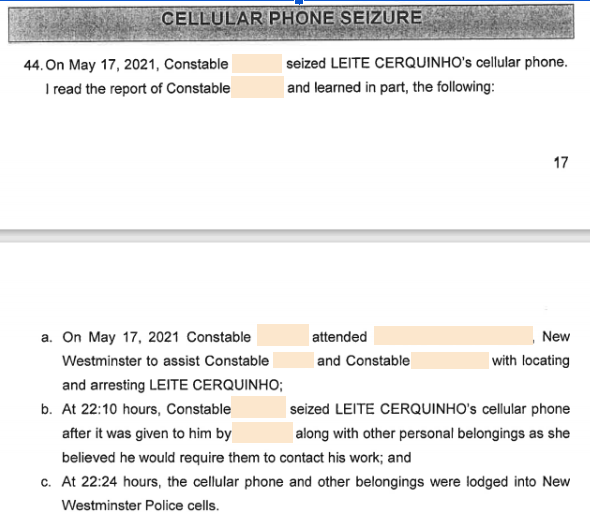
03 · Reported Sequence
Reported Sequence
The report describes a sequence in which a phone is transferred to the accused and subsequently taken into police custody.
“…the cellphone was handed to the accused and then seized…”
Source · Police Report — Cellular Phone Seizure
Highlighted sections indicate relevant portions of the document.
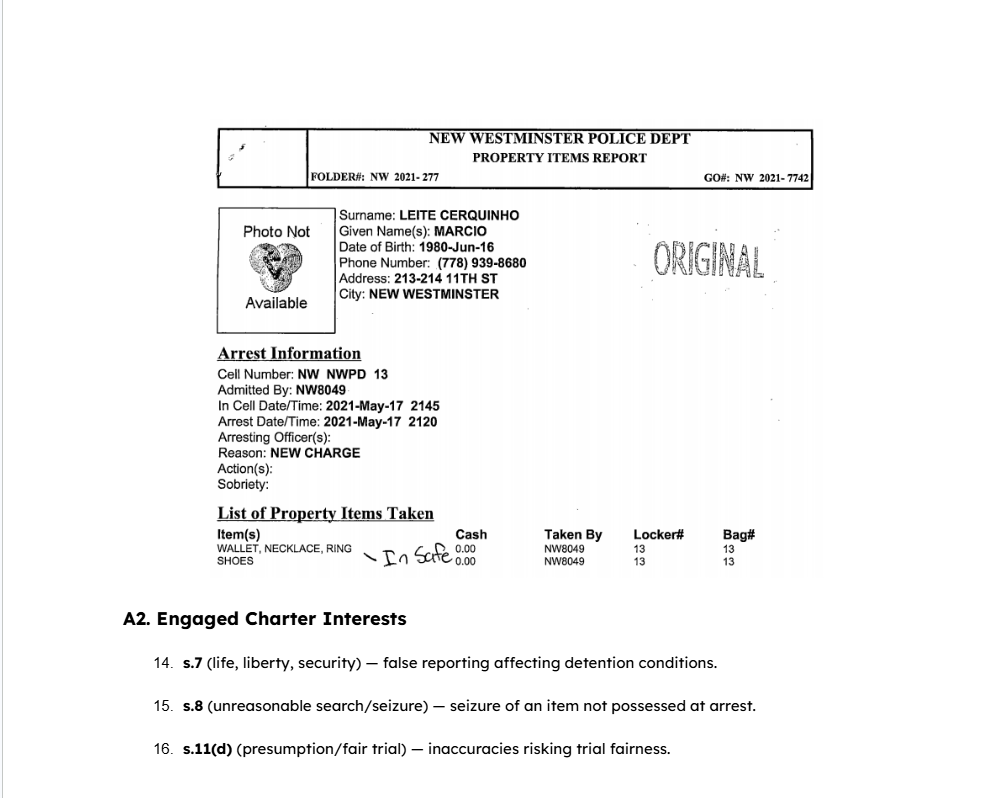
04 · Property Intake Record
Property Intake Record
Items recorded at intake include the following:
- ✓ Wallet
- ✓ Necklace
- ✓ Ring
- ✓ Shoes
✕ No cellphone listed
Source · Property Items Report
Observed Tension Between Records.
Property intake records are intended to reflect the items in an individual's possession at the time of detention.
The absence of a cellphone in the logged items introduces a point of tension when compared with the narrative description.
Viewed together, these records describe the same moment — yet they do not appear to reflect the same set of facts.
This divergence raises questions about how the sequence of events aligns across documented sources.
A question to consider
If a phone was seized,
why does it not appear in the intake record?
Timeline Consideration.
Available information suggests that the accused was already restrained and being escorted at the time the alleged transfer occurred.
This raises a practical question:
Practical question
At what point, under these conditions, could such a transfer have realistically taken place?
Continuity of Record.
The device does not appear in any formal evidence log on May 17, 2021 — nor in the days that followed.
On August 18, 2021, records indicate that a Huawei cellphone was formally received as an exhibit within a secured container.
This appears to be the first point at which the device enters the official evidence record.
Chain of Custody Consideration.
The period between May 17 and August 18 spans approximately three months.
Within the available documentation, no continuous chain of custody is clearly reflected during this interval.
In investigative contexts, continuity of record is typically an important factor in understanding how evidence is handled, transferred, and preserved.
A question to consider
If the device was in custody,
where was it recorded?
If it was recorded months later,
where was it in the meantime?
Purpose and Outcome.
The initial explanation for providing the device — to allow communication with work — appears difficult to reconcile with its subsequent use and delayed entry into the evidence record.
This contrast introduces additional uncertainty in how the sequence is understood.
Procedural Context.
The handling of personal property, particularly electronic devices, is generally guided by established procedural frameworks.
These frameworks are designed to ensure that actions taken during an arrest are consistent, documented, and subject to review.
Understanding these expectations is essential when examining how events are recorded and interpreted.
Documentation and Independent Record.
In many jurisdictions, body-worn cameras or similar systems provide an independent account of interactions.
Where such recordings are not available, the reconstruction of events relies primarily on written reports and administrative records.
This increases the importance of consistency between those records.
12 · Reflection
Between an initial request at a doorstep and a formal entry into evidence months later, the path of the device is not fully reflected within the available records.
Individually, each detail may appear minor.
Together, they form a sequence that invites closer examination.
And in early moments such as these, how events are recorded can shape everything that follows.